

Choosing the right vinyl matters just as much as choosing the right design. Whether you’re buying vehicle graphics, decals or business branding, the material influences how the finished graphics fit, perform and look over time.
Many buyers come across the terms cast vinyl and calendared vinyl without understanding why they exist. Each material is designed for a different purpose, and selecting the correct option depends on the surface, the expected lifespan and the demands placed on the graphics.
This guide explains the practical differences between cast and calendared vinyl, helping you make an informed decision before investing in custom graphics.
Manufacturing Process
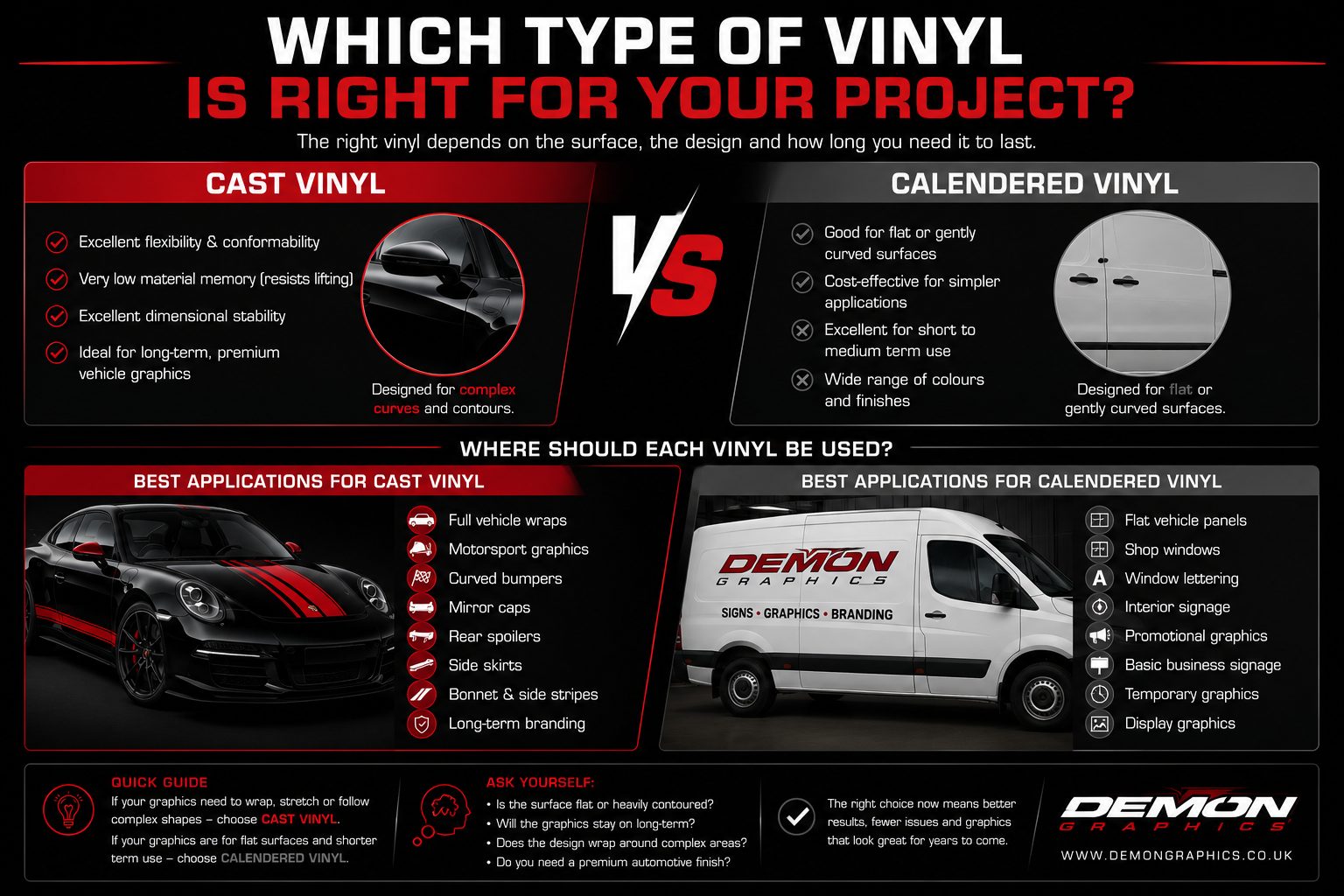
Cast vinyl is manufactured differently from calendared vinyl, giving each material distinct performance characteristics.
Cast vinyl begins as a liquid formulation that is poured onto a casting sheet before being cured. This creates a thin, highly stable film with very little internal stress.
Calendared vinyl starts as a thicker material that passes through heated rollers until it reaches the required thickness. The rolling process introduces more internal tension, giving the material a greater tendency to return towards its original shape after installation.
Understanding the production method makes it easier to see why each material performs differently once applied to a vehicle.
| Feature | Cast Vinyl | Calendared Vinyl |
| Manufacturing process | Liquid cast and cured | Heated and rolled |
| Thickness | Generally thinner | Generally thicker |
| Flexibility | Excellent | Good on flatter surfaces |
| Material memory | Very low | Higher |
| Dimensional stability | Excellent | Good |
| Typical use | Complex vehicle graphics | Flat graphics and signage |
The manufacturing process is only the starting point. The biggest differences become clear during installation and long-term use.
Flexibility And Conformability
Cast vinyl conforms far more effectively to curves, recesses and sculpted bodywork.
Modern vehicles include deep contours that require vinyl to stretch without creating tension. Cast vinyl accommodates these shapes while maintaining a smooth finish.
Typical examples include:
- Front bumpers
- Rear bumpers
- Mirror caps
- Wheel arches
- Side skirts
- Recessed door sections
- Rear spoilers
A Porsche front bumper or BMW side skirt contains multiple curves and changing angles. Cast vinyl adapts naturally across these surfaces, producing a cleaner installation with less stress on the material.
Calendared vinyl performs well on flat or gently curved panels. Once significant stretching becomes necessary, the material reaches the limits of its intended design. Selecting the correct vinyl from the outset reduces installation challenges and supports a better finished appearance.
Durability And Lifespan
Cast and calendared vinyl both deliver durable results when used for the applications they were designed to handle.
Cast vinyl is commonly selected for premium automotive graphics because it maintains colour consistency, resists UV exposure and performs well on demanding vehicle surfaces.
Calendared vinyl provides excellent performance across flatter applications, including many business graphics, decals and window displays.
Several factors influence long-term performance:
- Exposure to sunlight
- Weather conditions
- Surface preparation
- Cleaning methods
- Vehicle use
- Installation quality
No vinyl material can compensate for poor preparation or incorrect installation. Even premium products require clean surfaces, suitable temperatures and careful application to achieve the best possible result.
Resistance To Shrinking And Lifting
Material choice plays an important role in reducing edge lifting and unwanted movement after installation.
Cast vinyl contains very little internal memory. Once applied across complex curves, it remains stable with less tendency to pull away from the surface.
Calendared vinyl performs reliably on flat installations where minimal stretching is required. Applying it around deep recesses or highly sculpted panels places greater stress on both the material and the adhesive.
Installation technique also affects performance. Proper cleaning, careful positioning and firm pressure across edges all contribute to a longer-lasting finish.
The material and the installer work together. Neither should be considered in isolation.
Performance On Curved Vehicle Panels
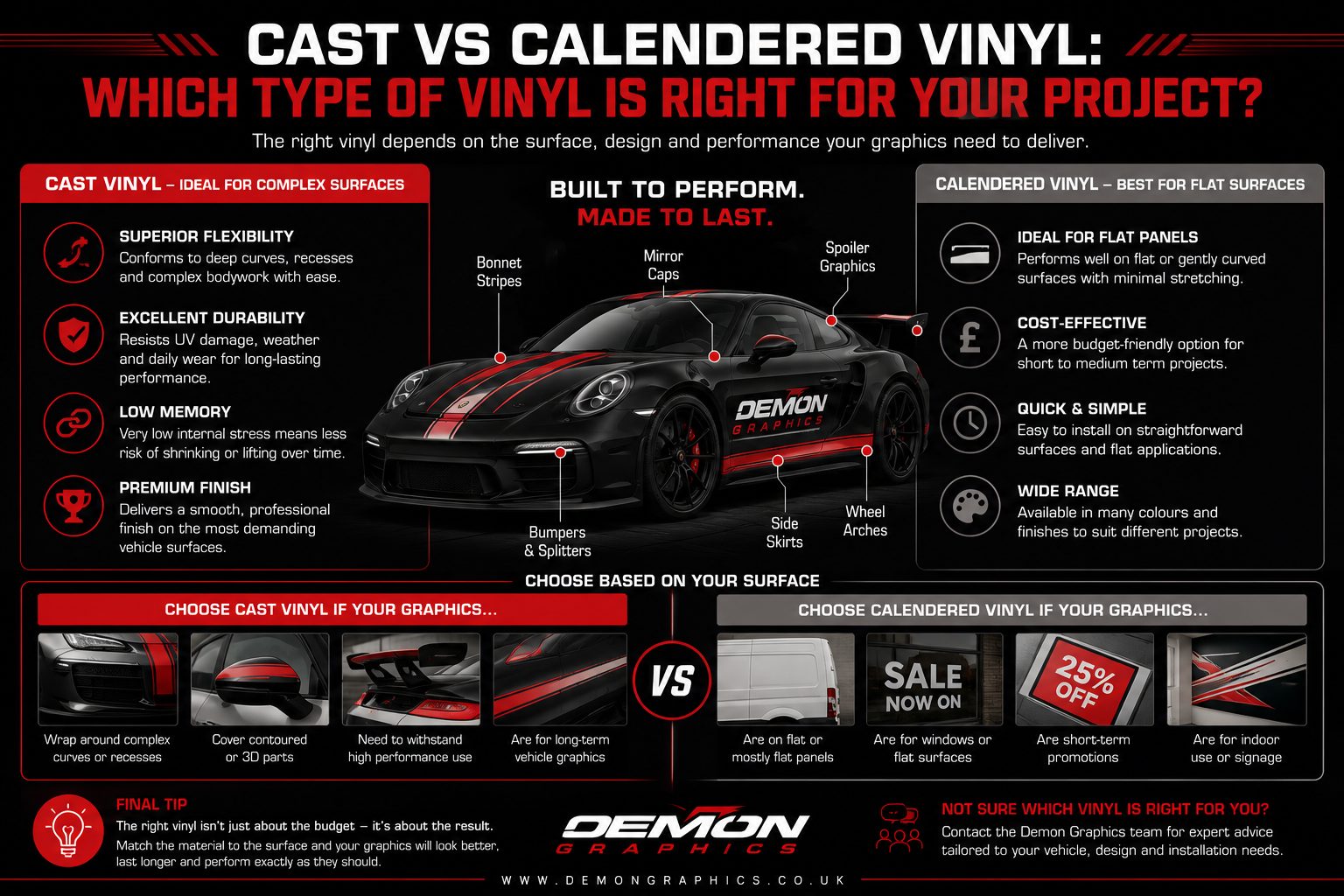
Vehicle body shape has a significant impact on vinyl selection.
Two graphics may look similar on screen while requiring completely different materials once fitted.
A commercial van door presents a largely flat surface with minimal contours. A performance car bumper features multiple curves, changing angles and recessed sections. Each surface places different demands on the vinyl.
| Vehicle Area | Recommended Vinyl | Reason |
| Porsche front bumper | Cast | Conforms around complex curves |
| BMW side skirts | Cast | Maintains stability across sculpted panels |
| Mirror caps | Cast | Wraps around tight contours |
| Rear spoiler | Cast | Handles changing angles |
| Flat van side panel | Calendared | Little stretching required |
| Shop window | Calendared | Flat installation surface |
Choosing material according to panel shape helps produce cleaner graphics while reducing unnecessary stress during installation.
Cost And Value For Money
The most expensive vinyl is not automatically the best choice.
Cast vinyl generally carries a higher initial cost because of its manufacturing process and performance characteristics. Where complex vehicle graphics remain in place for extended periods, the additional investment can represent good long-term value.
Calendared vinyl may offer better value for flatter applications where enhanced flexibility provides little practical benefit.
Instead of focusing solely on purchase price, consider the complete project.
Ask yourself:
- Is the surface flat or heavily contoured?
- Will the graphics remain fitted for an extended period?
- Does the design wrap around complex bodywork?
- Does the project require a premium automotive finish?
Answering these questions makes selecting the appropriate material much easier.
Best Applications for Cast Vinyl
Cast vinyl is well suited to projects involving complex surfaces or premium vehicle graphics.
Typical applications include:
- Full vehicle graphics
- Motorsport graphics
- Bonnet stripes
- Side stripes
- Performance vehicle decals
- Curved bumpers
- Mirror graphics
- Rear spoiler graphics
- Long-term commercial vehicle branding
These installations benefit from the flexibility and dimensional stability that cast vinyl provides.
Best Applications for Calendared Vinyl
Calendared vinyl performs extremely well across flatter surfaces where extensive stretching is unnecessary.
Suitable applications include:
- Flat vehicle panels
- Shop windows
- Temporary promotional graphics
- Interior graphics
- Basic business signage
- Flat decals
- Window lettering
- Display graphics
Many commercial projects achieve excellent results using calendared vinyl because the application itself places fewer demands on the material.
If you’re considering custom vinyl lettering, selecting the appropriate material for the installation surface helps achieve the best possible finish.
Which Type Of Vinyl Is Right for Your Project?
There is no universally superior vinyl. The right choice depends entirely on the intended application.
| Project | Recommended Vinyl |
| Side stripes | Cast |
| Curved bumper graphics | Cast |
| Motorsport graphics | Cast |
| Full vehicle graphics | Cast |
| Flat panel graphics | Calendared |
| Shop window graphics | Calendared |
| Temporary promotions | Calendared |
| Interior signage | Calendared |
The decision should always reflect the installation rather than the budget alone.
Where graphics need to wrap around mirrors, spoilers or sculpted bodywork, cast vinyl delivers the flexibility required for a professional finish.
Where surfaces remain flat and uncomplicated, calendared vinyl provides an excellent solution without paying for performance characteristics the project does not require.
Choosing the correct material from the beginning reduces the likelihood of lifting, shrinking and unnecessary replacement while delivering graphics that suit both the vehicle and the intended use.
If you’re unsure which material best suits your project, contact us and the Demon Graphics team will recommend the most appropriate option based on your vehicle, design and installation requirements.


