

Owning a business vehicle gives you an opportunity that many companies overlook. Whether you’re travelling between jobs, collecting supplies or parked outside a customer’s property, your vehicle can introduce your business to hundreds of people throughout the week without requiring another advertising budget.
The challenge isn’t simply adding your logo to the side of a van. It’s creating branding that people can recognise, understand and remember within a matter of seconds.
A well-designed vehicle doesn’t just advertise your business. It reinforces your professionalism, helps people remember your name and makes it easier for potential customers to contact you when they need your services.
In this guide, we’ll explain how to make every journey count, from choosing the right graphics to deciding what information belongs on your vehicle and what should be left off.
Turn Your Vehicle Into a Moving Advertisement with Car Graphics
A branded vehicle promotes your business wherever you drive, helping more people recognise your company without paying for ongoing advertising.
Unlike many forms of marketing that stop working when your budget runs out, vehicle graphics continue promoting your business every time you use your car or van. Whether you’re travelling across town, parked outside a customer’s home or sitting in traffic, your branding is working quietly in the background.
That doesn’t mean every business needs a full vehicle wrap.
One of the biggest misconceptions is that covering every panel with graphics automatically creates a stronger impression. In reality, the most memorable designs are often the simplest. A clean layout with clear branding is far easier to recognise than a vehicle covered in competing colours, text and images.
Ask yourself one question:
If someone only saw your vehicle for three seconds, what would they remember?
If the answer isn’t immediately obvious, your design is probably trying to communicate too much.
For many small businesses, vehicle graphics, partial wraps, vinyl lettering or professionally positioned decals provide all the visibility they need whilst keeping the vehicle smart and approachable, particularly when the design focuses on clear branding rather than trying to fill every panel.
For example, an electrician might include:
- Company logo
- “Domestic & Commercial Electrician”
- Telephone number
- Website
- Service area
That tells potential customers everything they need to know without overwhelming them.
The goal isn’t to fill every available space. It’s to make your business instantly recognisable.
Think Like the Person Behind You
One of the easiest ways to judge a vehicle design is to imagine you’re sitting at traffic lights behind it.
Can you answer these four questions within five seconds?
- Who is this business?
- What do they do?
- How can I contact them?
- Would I remember them later?
If the answer to any of those questions is “no”, simplifying the design will usually be more effective than adding more information.
This is something we regularly consider when creating custom vehicle graphics. Every element should have a purpose. If it doesn’t improve recognition or help someone get in touch, it may not need to be there at all.
Use Car Stickers to Display Your Brand
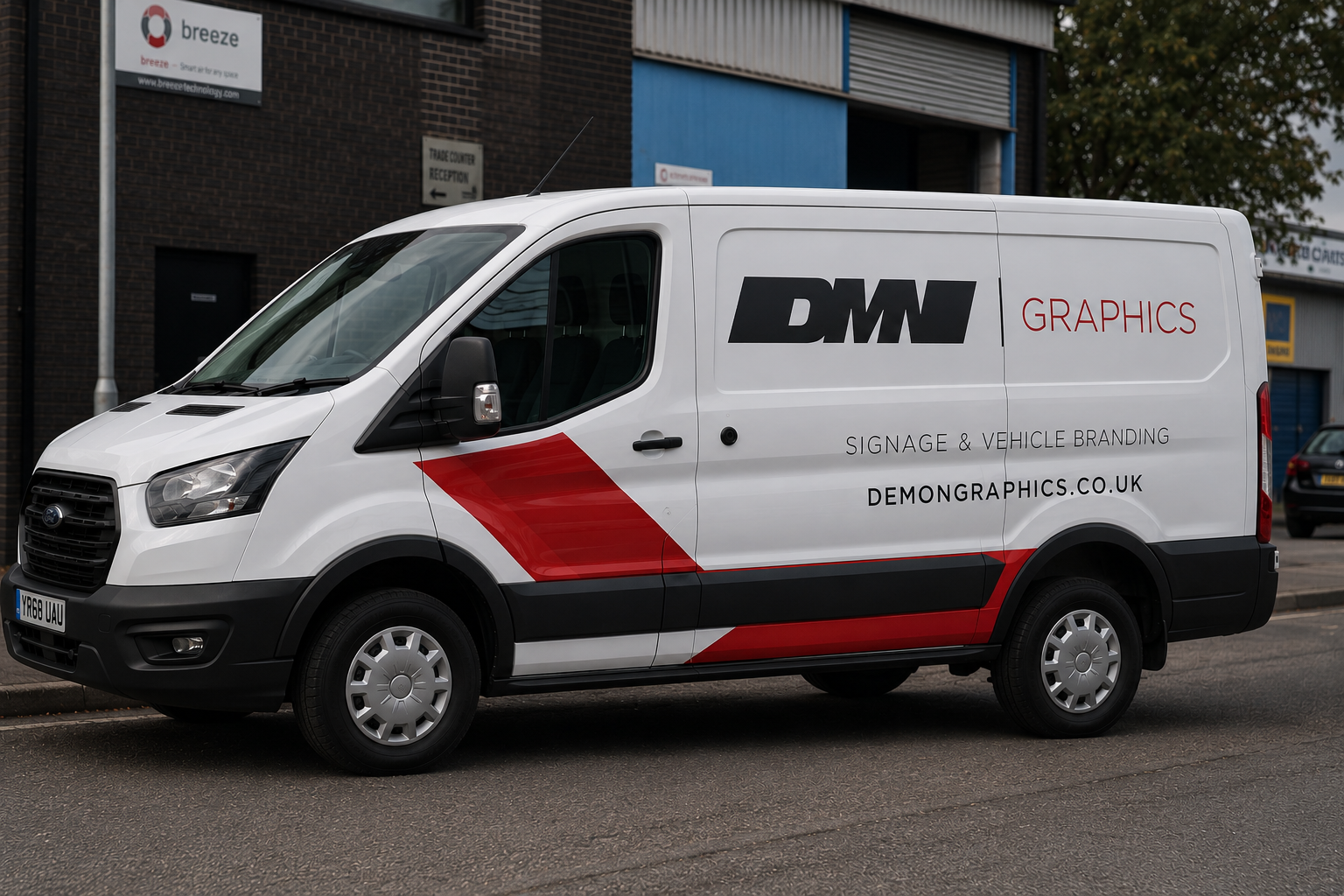
Car stickers provide one of the easiest and most affordable ways to advertise whilst driving.
Not every business needs a complete graphics package from day one. If you’re working with a smaller budget or want to brand a personal vehicle without permanently changing its appearance, professionally produced stickers can make a significant difference.
They work particularly well for sole traders, gardeners, landscapers, mobile dog groomers, driving instructors, cleaning companies and home-based businesses, especially when car stickers become part of a wider local marketing strategy.
Rather than treating stickers as decoration, think about the different ways vehicle branding can reinforce your business identity, from subtle logos through to larger promotional graphics.
A well-positioned logo on the rear of your vehicle may be seen far more often than graphics placed on the bonnet. Likewise, a pair of professionally produced decals on the rear side panels can create a cleaner, more balanced appearance than multiple smaller stickers placed randomly around the vehicle.
Before ordering any business stickers, consider:
- Which side of the vehicle is most visible when parked?
- Will your logo contrast clearly against the paint colour?
- Is the lettering large enough to read from several metres away?
- Will the design still look professional after years of regular use?
These practical questions often have a greater impact on results than the size of the graphic itself.
One Common Mistake We See Repeatedly
Many businesses try to turn their vehicle into a brochure.
It’s understandable. You’ve paid for the space, so naturally you want to include everything:
- Every service
- Every qualification
- Every phone number
- Every social media platform
- Every postcode
- Every slogan
The result?
Nothing stands out.
The human brain processes shapes and simple messages much faster than paragraphs of text. Someone driving past isn’t going to read ten different services listed down the side of your van.
They’re much more likely to remember:
Smith Electrical
Domestic & Commercial Electrician
That’s enough to create recognition. The rest can happen when they visit your website.
Add Window Stickers for Extra Visibility
Window graphics allow you to use otherwise unused space without dramatically changing your vehicle’s appearance.
When designed well, window stickers can complement your existing branding and increase visibility without making your vehicle feel overcrowded. They’re particularly useful for vans, SUVs and estate cars where large rear windows provide valuable advertising space.
However, they’re not a solution for every vehicle.
Before adding window graphics, consider three questions:
- Will they reduce visibility for the driver?
- Can the message still be read from a sensible distance?
- Are they positioned within current legal requirements?
A professionally designed rear window decal can display your website, logo or company name whilst leaving the main bodywork clean and uncluttered. Side window graphics work well for service lists or subtle branding, provided they don’t compete with the primary message on the vehicle’s doors.
Window Graphics Checklist
Before approving your design, check that:
- Your company name remains the most prominent element.
- Text is large enough to read without straining.
- Colours contrast against tinted glass.
- Important information isn’t hidden behind wipers or window frames.
- The graphics don’t interfere with the driver’s visibility.
The aim is to support your branding, not overwhelm it.
Include Your Contact Details on Your Vehicle
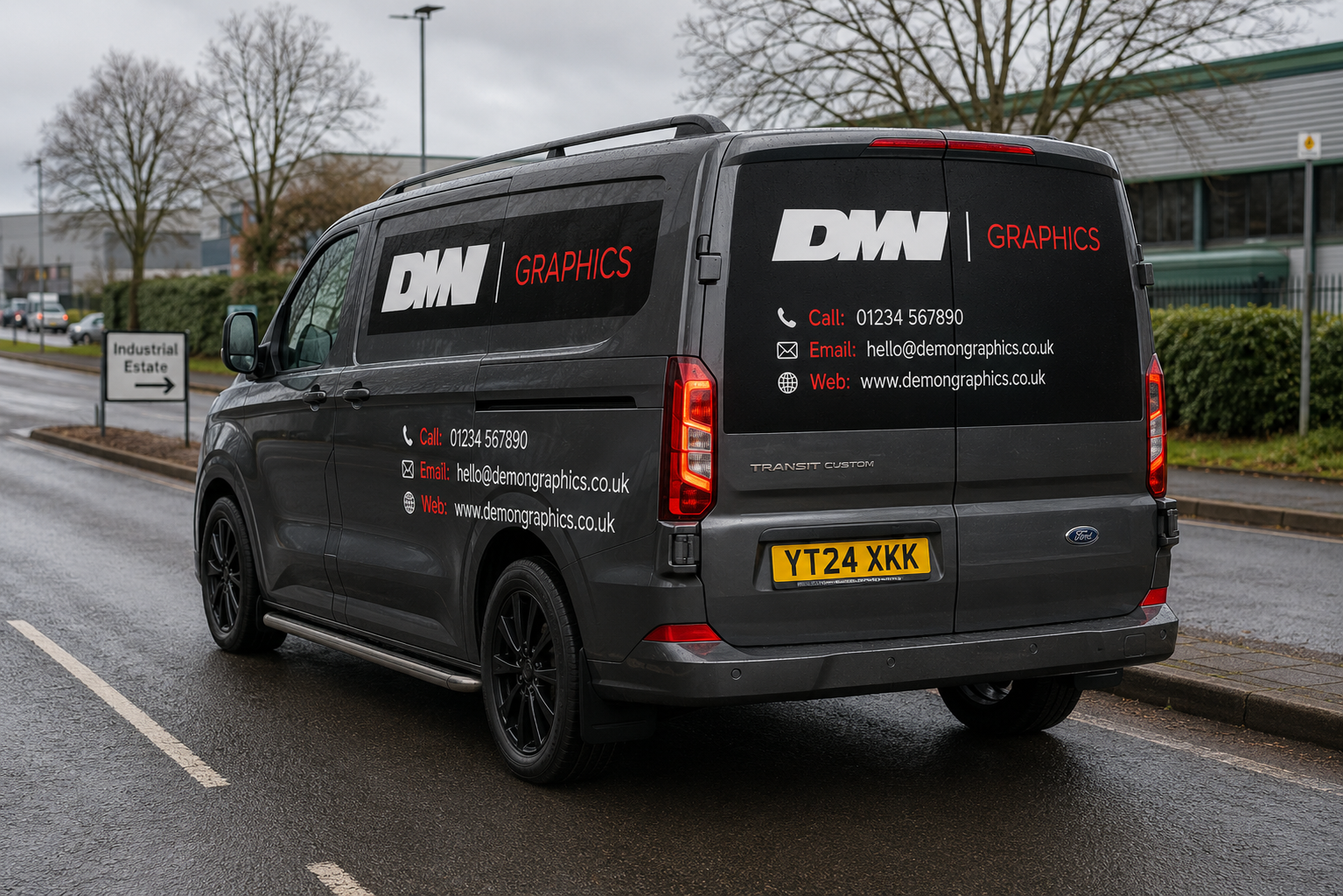
Potential customers should immediately know who you are and how to contact you.
This is where many otherwise attractive vehicle graphics fall short. Businesses often spend time choosing colours and layouts but give very little thought to the order in which information should appear.
Think about how someone discovers your business while driving.
They’re unlikely to write down your phone number immediately. They’re much more likely to remember your company name or website and look you up later.
With that in mind, your information should follow a clear hierarchy.
| Priority | Information | Why it matters |
| First | Company name or logo | Builds instant recognition. |
| Second | What you do | Helps people decide if you’re relevant. |
| Third | Website | Easy to remember and visit later. |
| Fourth | Telephone number | Ideal when someone is parked or stopped safely. |
| Fifth | Service area | Helps attract local enquiries. |
| Last | Email address | Useful, but rarely the first contact method people notice. |
One question is worth asking before finalising any artwork:
If someone only remembered one thing from your vehicle, what would you want it to be?
For most businesses, that answer should be the company name.
Your branding should lead the design. Contact information should support it.
If your logo is hidden beneath a large phone number or squeezed into a corner, the overall message becomes much less memorable.
Custom vinyl lettering is an excellent option for displaying business names, websites and contact details with a clean, professional finish, especially if you prefer understated branding over large graphics.
Promote Your Website and Social Media
Your vehicle should encourage people to continue engaging with your business after they’ve seen it.
A well-branded vehicle often creates curiosity. Someone may notice your van outside a customer’s property, at a petrol station or in traffic, but they won’t necessarily need your services at that exact moment.
That’s why your website is one of the most valuable pieces of information you can display.
Unlike a telephone number, which people are unlikely to memorise whilst driving, a short website address is much easier to recall later.
Social media can also be valuable, particularly if your work is highly visual.
For businesses such as:
- Landscapers
- Vehicle detailers
- Builders
- Decorators
- Garden designers
Instagram and Facebook provide potential customers with immediate proof of your work.
That doesn’t mean every platform deserves a place on your vehicle.
Displaying six different social media icons rarely adds value. Instead, choose the platform where you’re most active and where prospective customers are most likely to find recent examples of your work.
For many businesses, one Instagram handle is far more effective than displaying Facebook, TikTok, LinkedIn, X and YouTube together, particularly if you’re trying to encourage more people to follow your business after seeing your vehicle.
Should You Include a QR Code?
QR codes can bridge the gap between offline advertising and your online presence, provided they’re used thoughtfully.
Over the past few years, they’ve become increasingly common on business vehicles, but that doesn’t mean every QR code is useful.
In fact, many are simply too small to scan. Others link to a generic homepage instead of something genuinely helpful.
If you’re considering adding one, think beyond the technology itself.
Ask:
- What happens after someone scans it?
- Does it lead to your contact page?
- Does it showcase recent work?
- Does it offer a quotation form?
- Is the destination mobile-friendly?
The landing page matters just as much as the code.
Where Should a QR Code Go?
Good locations include:
- Rear doors of vans
- Side-loading doors
- Areas people are likely to view whilst the vehicle is parked
Avoid placing QR codes where someone might feel tempted to scan whilst your vehicle is moving. They work best when customers can safely approach the vehicle on foot or when it’s stationary.
And before printing, always test the code on multiple phones from different distances. A QR code that looks perfect on screen can quickly become frustrating if it’s too small or printed with insufficient contrast.
Advertise Your Services Without Cluttering Your Vehicle
Highlighting one or two key services is usually more effective than trying to advertise everything.
This is perhaps the biggest design lesson experienced vehicle branding specialists learn over time.
Many business owners worry that if they don’t mention every service they offer, they’ll lose enquiries.
In practice, the opposite is true. A simple message is often easier to understand.
Imagine these two examples.
Vehicle One
- Plumbing
- Heating
- Boilers
- Bathrooms
- Drainage
- Gas Safe
- Maintenance
- Servicing
- Repairs
- Installations
- Emergency Callouts
- Commercial
- Domestic
Vehicle Two
Smith Plumbing
Plumbing & Heating Specialists
smithplumbing.co.uk
Which one could you remember after driving past? Almost certainly the second.
Once someone visits your website, you can explain every service in detail.
Your vehicle’s job is simply to make them interested enough to take that next step.
Keep Your Vehicle Clean and Professional
Even the best graphics lose their impact if the vehicle is dirty or poorly maintained.
A professionally designed vehicle communicates attention to detail. That impression quickly fades if peeling vinyl, faded stickers or road grime hide the branding beneath.
Fortunately, looking after vehicle graphics doesn’t require specialist equipment.
Simple habits make the biggest difference.
- Wash the vehicle regularly using suitable cleaning products.
- Remove bird droppings and tree sap promptly.
- Avoid directing high-pressure washers at vinyl edges.
- Inspect graphics periodically for lifting corners.
- Replace damaged decals before they become more noticeable.
Think of your graphics as part of your company’s image.
If a potential customer sees a clean, well-maintained vehicle, they’re more likely to assume you’ll take the same care with the work you deliver.
Make Every Journey Count
Every journey is an opportunity to introduce your business to someone new, but effective vehicle advertising isn’t about covering every panel with logos and text.
It’s about communicating the right information, in the right order, with a design that’s easy to recognise at a glance.
Whether you choose full vehicle graphics, vinyl lettering, window decals or professionally produced business stickers, clarity will always outperform clutter.
Before approving any design, ask yourself one final question:
Would someone who has never heard of my business understand who I am, what I do and how to contact me within five seconds?
If the answer is yes, you’re already ahead of many businesses on the road.
If you’re considering branding your vehicle and want graphics that reflect your business professionally, get in touch with Demon Graphics to discuss a solution that suits your vehicle, your budget and the way you work.


