

Jaguar has always built cars around proportion and precision.
From the sweep of an F-Type’s bonnet to the clean surface transitions on an I-Pace, every line is intentional.
The front fascia of Jaguars, in particular, is treated as a cohesive design statement. Grille placement, bumper contour, lower intakes and sensor integration are resolved together, not as separate elements.
Within that sits the number plate.
It may be a legal requirement, yet it occupies a prominent position directly beneath the grille and on the vehicle’s centreline.
On many Jaguar models, the surface intended for plate mounting is not flat. It curves. It tapers. It integrates sensors and structural reinforcements behind the visible skin. This is where the issue often arises.
A standard acrylic plate is manufactured flat. Jaguar bumpers often are not. Fixing a flat plate directly to a shaped bumper can introduce stress, misalignment or vibration over time. What seems minor at installation can gradually affect fit, finish and overall presentation.
A Jaguar number plate holder exists to resolve that interface. It creates structure between the plate and the bumper. It protects paintwork. It supports correct alignment. It helps maintain the clean, OEM appearance expected of a premium vehicle.
Understanding why that matters begins with Jaguar’s design approach.
Why Jaguar Models Use a Different Number Plate Holder Setup
Jaguar does not design its front bumpers around the convenience of plate installation. Instead, the bumper is shaped for airflow efficiency and visual tension, with the plate accommodated within that structure.
On many models, the bumper surface beneath the grille curves horizontally across its width and arcs subtly along its height. This compound curvature reduces the flat mounting area available for direct attachment.
When a flat plate is fixed directly to such a surface, two outcomes are common. Either the centre sits flush, and the edges lift slightly, or the corners are tightene,d and the centre bows inward. In both cases, tension is introduced into the plate.
Lower grille placement further complicates matters. Jaguar front ends often feature a high-mounted grille with sculpted lower intakes beneath. Behind the bumper skin, structural ribs, sensor housings and ducting restrict where screws can be safely positioned. Drilling without consideration risks compromising internal architecture.
Minimalist styling adds another layer of precision. Jaguar’s design language depends on symmetry. The plate must sit level and centred relative to the grille aperture. Even a slight rotational misalignment becomes noticeable against gloss black mesh and sharply defined creases.
For these reasons, many Jaguar models rely on a model-specific Jaguar plate bracket. Rather than forcing a flat component onto a shaped surface, the bracket establishes a stable mounting plane. It reconciles geometry without distortion.
Design-first engineering inevitably influences plate mounting.
What a Jaguar Number Plate Holder Is and What It Does
A Jaguar number plate holder is not simply a decorative surround. It is a structural mounting interface engineered to support the plate against the bumper’s curvature.
Its primary function is support.
By distributing load across a wider contact area, the holder reduces stress concentration around screw points. This prevents plate warping over time, particularly on curved front ends where tension would otherwise persist.
It also protects painted surfaces. Direct contact between plate and bumper can lead to subtle abrasion as vibration transfers through the vehicle structure. A holder introduces controlled spacing, reducing the likelihood of micro-marking beneath the plate edge.
Alignment is equally important.
UK regulations require plates to be securely fixed and positioned vertically or as close to vertical as practicable. On a shaped bumper, direct mounting may alter the plate’s angle. A Jaguar front plate holder ensures the plate sits correctly relative to the road surface and grille centreline.
In short, it provides structure, protection and precision.
Common Reasons Why Your Jaguar Needs a Number Plate Holder
While aesthetics matter, practical considerations are often the deciding factor.
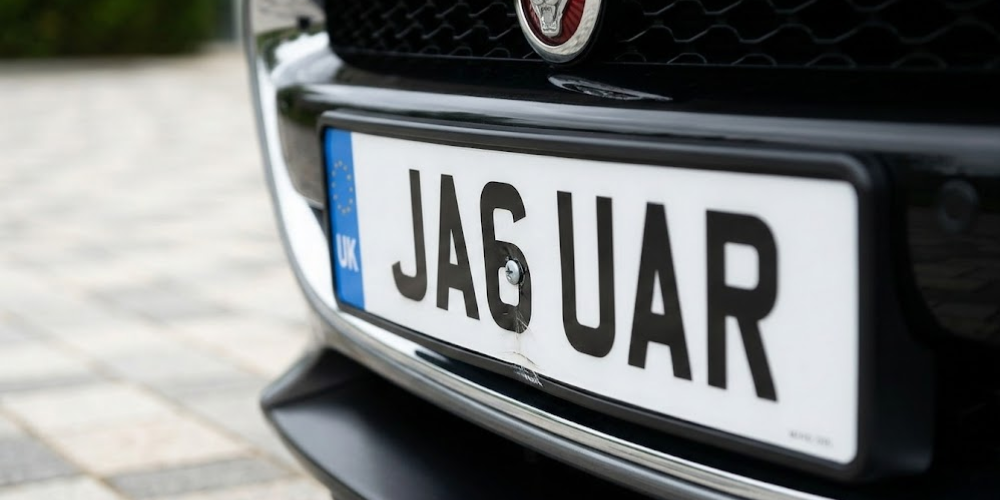
Avoiding Direct Drilling Into Painted Bumpers
Modern Jaguar bumpers are finished in multi-layer paint systems. Drilling directly through visible surfaces introduces permanent modification. Over time, movement around fixings can enlarge holes or create lacquer stress marks.
A properly designed Jaguar number plate mounting system uses controlled fixing points and distributes load without unnecessary additional drilling.
Correcting Plate Curvature
On models with pronounced nose profiles, direct attachment frequently leads to visible bowing. Temperature changes and airflow pressure can exaggerate this distortion.
A Jaguar plate bracket stabilises the plate against curvature, keeping it flat and evenly supported.
Reducing Vibration Damage
At motorway speeds, airflow exerts pressure across the plate surface. Unsupported plates can oscillate subtly, placing repeated stress on screw apertures or adhesive bonds.
A structured Jaguar front plate holder dampens this movement by spreading vibration across its frame.
Improving Aerodynamic Consistency and Fit
Jaguar front ends are shaped to guide air cleanly across the nose and into lower intakes. A plate that lifts at one edge or sits unevenly can disrupt that visual and aerodynamic continuity.
A flush, premium number plate frame maintains alignment with bumper contours and preserves front-end coherence.
Factory-Fitted vs Dealer-Fitted Jaguar Number Plate Holders
It’s important to remember that not all mounting solutions are equal, and it depends on who fits them.
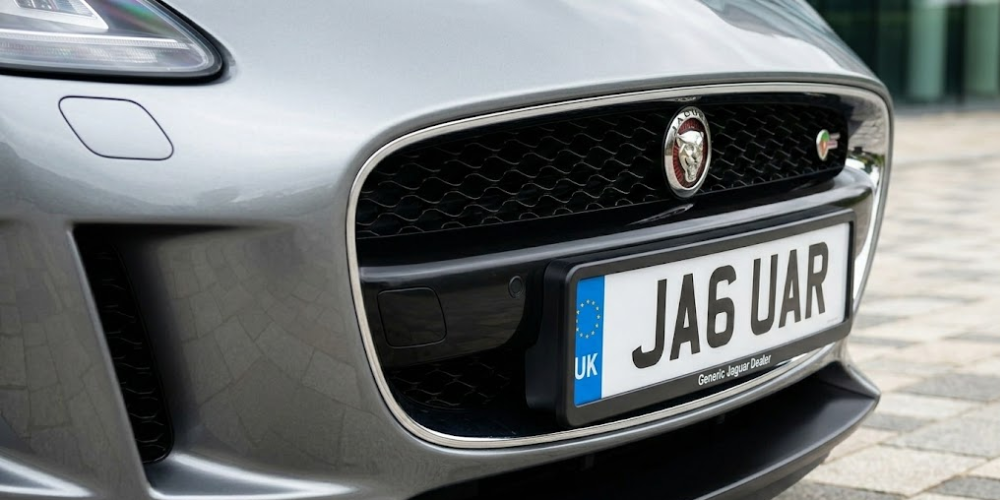
Factory-Fitted Systems
When Jaguar designs a vehicle, plate positioning is considered alongside grille alignment and sensor placement. Factory-installed brackets are typically low-profile and shaped to follow bumper curvature. They align precisely with structural reinforcement zones behind the bumper.
The result appears integrated rather than added.
Dealer-Fitted Frames
Dealer-installed frames are usually fitted during pre-delivery preparation. Many feature printed dealership branding and rely on universal plastic surrounds.
While functional, these frames often introduce additional perimeter bulk and visible branding not present in the original design language. Over time, lower-grade plastics may fade or become brittle.
From an aesthetic standpoint, replacing a dealer surround with a clean Jaguar number plate holder restores the restrained OEM look.
Resale perception can benefit from this refinement. A flush, model-correct Jaguar plate bracket signals attention to detail.
How Jaguar Design Choices Affect Number Plate Holders
Jaguar’s front-end design is built around proportion and tension. The number plate must sit within that framework without disrupting it.
Sweeping Bumper Lines
Compound curvature creates visual movement across the nose. Without a neutral mounting plane, a plate may distort to match that shape. A holder prevents this distortion while preserving bumper form.
Parking Sensors and Camera Integration
Modern Jaguars integrate ultrasonic parking sensors across the bumper. Incorrect bracket placement can partially obstruct detection zones. On higher-specification models, front cameras are calibrated relative to expected plate position.
A correctly dimensioned Jaguar number plate mounting solution maintains necessary clearance.
Gloss Black Trims and Grille Spacing
Jaguar often contrasts body colour with gloss black mesh and grille surrounds. Bulky universal frames can disrupt this balance. A refined Jaguar front plate holder sits discreetly, maintaining visual hierarchy.
The Importance of Symmetry
Jaguar design relies on central alignment. A plate that is even slightly skewed becomes immediately apparent. A model-specific bracket ensures consistent centring beneath the grille.
Which Jaguar Models Are Most Affected
F-Type
The F-Type’s projecting nose and limited flat mounting area make curvature management critical. Direct installation commonly results in central bowing. A dedicated Jaguar front plate holder stabilises the plate against this compound curve.
XE and XF
These sport saloons feature sculpted bumper recesses that taper subtly toward the edges. Universal frames can overlap crease lines. A model-specific Jaguar plate bracket ensures flush integration.
F-Pace and E-Pace
SUV models present wider bumper surfaces and multiple parking sensors. Maintaining sensor clearance and visual symmetry is essential. A correct Jaguar number plate mounting system provides structured alignment.
I-Pace
The I-Pace adopts a clean, aerodynamic front design with minimal grille depth. Because the surface is visually uninterrupted, any distortion becomes obvious. OEM Jaguar plate fitment standards are particularly visible here.
Is It Legal to Drive Without a Jaguar Number Plate Holder?
UK law does not require a specific holder. It requires that the number plate is securely fixed, clearly visible and positioned correctly.
Under the Road Vehicles (Display of Registration Marks) Regulations and guidance, plates must not be likely to fall off. The DVSA MOT Inspection Manual reinforces that they must be secure during normal use.
A Jaguar number plate holder is therefore not mandatory in itself.
However, on curved bumpers where direct mounting may allow movement or distortion, a holder provides a reliable way to maintain secure attachment. If a plate bends significantly or vibrates excessively, it could attract attention during inspection.
Secure mounting, not the hardware itself, is the legal requirement. A structured bracket often provides the most dependable solution.
Should You Fit a Replacement Jaguar Number Plate Holder?
There are several situations where replacement is sensible.
- When the original bracket has cracked or loosened.
- When removing dealer-branded frames for a cleaner appearance.
- When converting to shorter, legally compliant plates.
- When restoring or detailing the vehicle’s front end.
A worn or faded bracket undermines the refined look of the vehicle. Replacing it with a properly specified Jaguar number plate holder restores structural integrity and visual cohesion.
How to Choose the Right Number Plate Holder for Your Jaguar
Selecting correctly involves more than matching plate dimensions.
Model-Specific Sizing
Confirm compatibility with the exact Jaguar model and generation. Bumper geometry can differ between facelifts.
High-Quality Materials
UV-resistant plastics maintain rigidity and finish under prolonged exposure. Inferior materials may crack or fade.
Flush Fit Design
The holder should follow the bumper contour without visible gaps or protrusions.
Secure Fixing System
Look for clip or screw systems that distribute load evenly and avoid unnecessary drilling.
Sensor Compatibility
Ensure adequate clearance around parking sensors and cameras.
When specified correctly, the holder becomes an almost invisible, supporting structure without drawing attention.
Jaguar’s front-end design is deliberate and balanced. The registration plate forms part of that composition, even if it is mandated by regulation.
On models with curved bumper geometry and integrated assistance systems, direct mounting without structural mediation can introduce tension, vibration and aesthetic compromise. A correctly specified Jaguar number plate holder resolves those issues with clean precision.
Demon Graphics specialises in model-specific Jaguar number plate mounting solutions designed to align with factory bumper architecture. The brand is also a recognised destination for Jaguar decals, subtle styling enhancements and performance-inspired modifications across the wider range.
If you are considering upgrading or replacing your current setup, you can contact us for tailored advice.


