

Preparing your car for an automotive event involves more than getting the paintwork clean and choosing where to park. The stickers you display can communicate your interests, identify your club, acknowledge sponsors or help visitors find your social media accounts.
However, adding graphics without a plan can leave the vehicle looking cluttered. Whether you’re attending a local meet, modified car show or motorsport event, each sticker should have a clear purpose.
Here’s how to choose, position and coordinate stickers for your next event.
Personalise the Car Around a Clear Theme
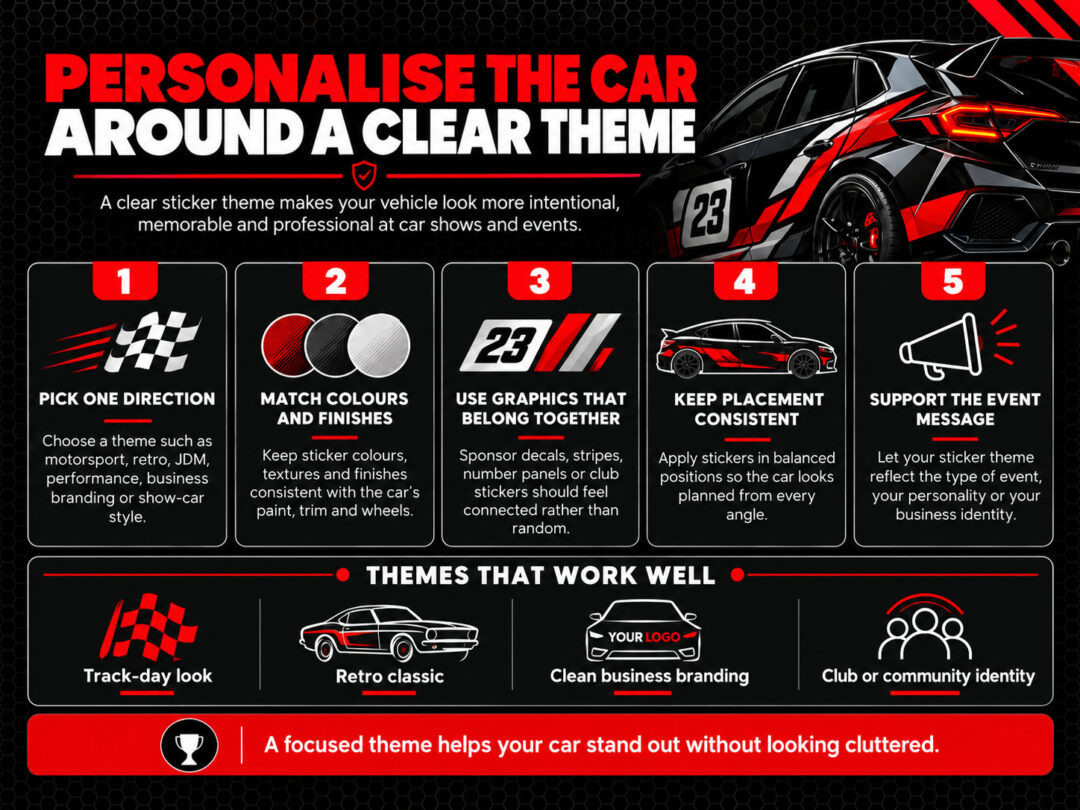
Stickers can give a show car a recognisable identity when the graphics follow a consistent theme. Choose a direction that complements the vehicle before deciding which designs to add.
Motorsport-inspired stripes, manufacturer graphics and Japanese Domestic Market (JDM) designs each create different visual effects.
Match Stickers to the Rest of the Car
Consider your paint colour, alloy wheels, badges and existing modifications when choosing graphics.
A Japanese performance car with contrasting wheels might suit carefully positioned JDM designs, while a Porsche with understated modifications may benefit from restrained side stripes.
Demon Graphics offers a range of car stickers suited to different vehicle styles, allowing you to choose graphics that complement your car’s existing features rather than compete with them.
Use Stickers to Highlight Modifications Selectively
Graphics can draw attention to particular features without covering every panel.
For example, a small performance-related decal near a modified component may contribute more to the overall presentation than several unrelated logos.
Show Your Club or Community Identity
Matching stickers help identify vehicles belonging to the same car club, community or event convoy without requiring identical designs.
A group attending a Volkswagen show might display its club logo on each vehicle’s rear quarter window.
To create a coordinated appearance:
- Agree on a consistent logo design.
- Choose complementary colours.
- Use similar positioning across vehicles.
- Keep the dimensions proportionate to each car.
This approach establishes a shared identity while allowing individual modifications and styling choices to remain visible.
Make Social Media Details Easy to Find
Social media stickers help visitors find your online content after seeing your car at an event. Clear, readable usernames work best.
For creators sharing modifications or track days, consider:
- Lettering: Choose an easily recognised font.
- Contrast: Ensure text remains visible against the surface.
- Placement: Avoid curves and crowded areas.
- Consistency: Match your online username.
One clear handle is preferable to several competing graphics.
Display Sponsors Without Letting Them Take Over the Car
Sponsor stickers should identify supporting brands without overwhelming your vehicle’s design. A coordinated layout keeps logos readable and visually balanced.
For motorsport-inspired cars, consider grouping sponsor graphics along a door or front wing.
Maintain consistent spacing, appropriate proportions and clear contrast between logos and paintwork. Always obtain permission before reproducing protected branding.
For more inspiration on positioning graphics, explore these ways to use car stickers to create a cohesive display for your next automotive event.
Use Entry Numbers and Vehicle Information Where They Add Value
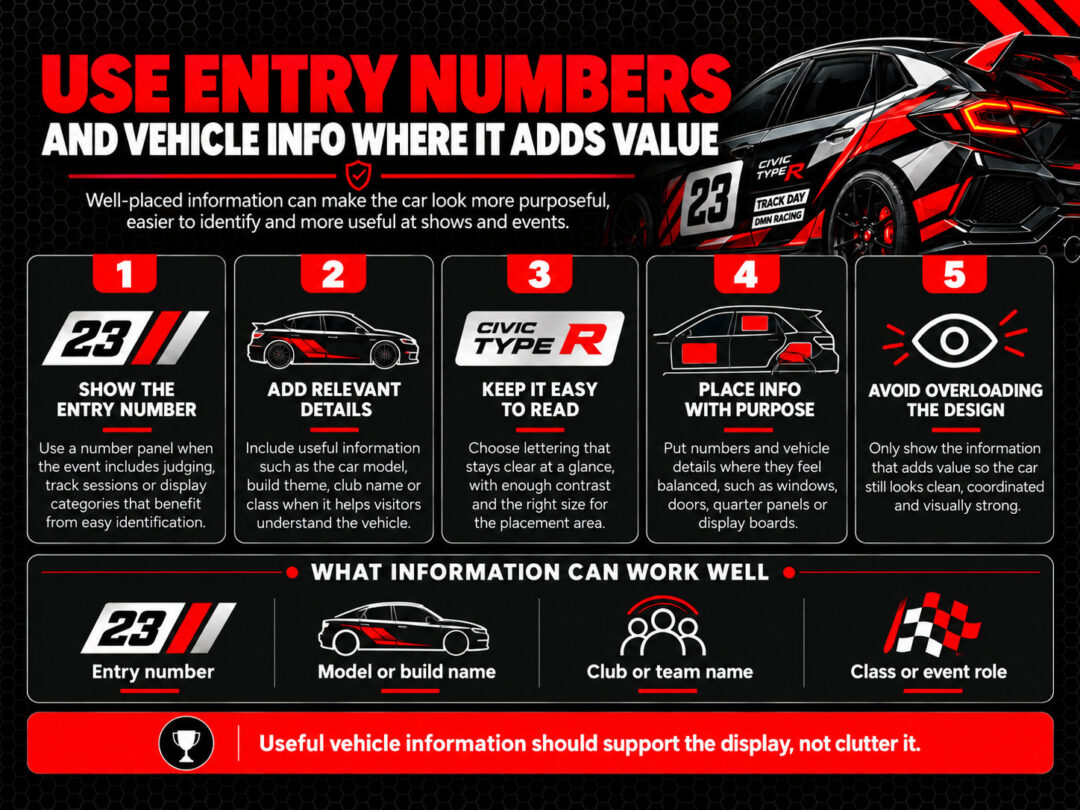
Entry numbers and vehicle details help visitors understand your car’s purpose, particularly at organised shows and motorsport events.
A track-focused car might display its competition number alongside selected modifications.
Useful information includes:
- Event or competition numbers.
- Vehicle model and year.
- Significant modifications.
- Relevant technical specifications.
Avoid overcrowding panels with lengthy descriptions. A separate display board works better for detailed information.
Always check organiser requirements for competition number sizing, colours and placement before applying graphics.
Promote an Automotive Business Without Making the Car Look Like an Advert
Business stickers should clearly communicate your services without overwhelming the vehicle’s appearance.
For example, a detailing company attending a car show could display its logo, “Vehicle Detailing” and a social media handle.
Focus on essential information rather than lengthy service lists. Consider whether your vehicle serves primarily as a showpiece or promotional display.
For further guidance, explore how to use car stickers for business branding while maintaining a professional, coordinated appearance.
Use Window Stickers Carefully
Window stickers provide additional space for club logos, usernames and event information, provided they do not compromise driver visibility.
Rear side windows may offer suitable positions for smaller graphics, depending on the vehicle’s design.
Avoid placing stickers where they obstruct essential sightlines or interfere with the driver’s view.
Before applying windscreen graphics, review the relevant car windscreen sticker laws and current UK requirements. Event organisers may also impose additional restrictions.
A display arrangement that works while parked must remain appropriate when driving on public roads.
Create Event-Specific or Commemorative Stickers
Commemorative stickers provide a lasting reminder of a particular car show, club gathering or road trip.
A car club attending its annual meet might choose a shared design featuring the event name, location and date.
Other possibilities include anniversary graphics, convoy identifiers or stickers celebrating a completed restoration.
Keep commemorative designs proportionate to the available space. A discreet graphic can preserve the memory without interfering with the vehicle’s established appearance.
Seek permission before incorporating official event artwork or protected logos.
Know When the Car Already Has Enough Stickers
More stickers do not necessarily produce a better automotive display. An overcrowded design can make individual graphics harder to recognise and weaken the vehicle’s overall appearance.
Watch for conflicting colour schemes, repeated usernames, inconsistent lettering and sponsor logos scattered across unrelated panels.
Ask What Each Sticker Is Doing
Before adding another graphic, consider its purpose.
Does it identify your club, communicate information, acknowledge a sponsor, promote your work or complement the existing styling?
If the answer is unclear, reconsider its placement or whether it belongs on the vehicle.
A car with established racing stripes, sponsor graphics and a visible social handle may already communicate everything visitors need to know.
What Should You Plan Before a Car Show or Automotive Event?
Preparing event stickers starts with identifying their purpose, checking organiser requirements and choosing placements that complement your vehicle’s existing graphics.
Before ordering, follow this checklist:
- Define your purpose: Decide what each sticker should communicate.
- Prioritise information: Include only essential graphics and details.
- Check event rules: Confirm restrictions on stickers and competition numbers.
- Verify permissions: Obtain approval before reproducing protected logos.
- Review existing graphics: Identify designs worth keeping.
- Measure placement areas: Check available space and vehicle contours.
- Proofread details: Confirm usernames, spelling and numbers.
- Allow preparation time: Plan for ordering and application.
- Inspect the layout: Review the complete vehicle from different angles.
Before applying stickers, clean and dry the surface thoroughly. Avoid damaged paintwork and follow the product’s application instructions.
For event-specific graphics, contact Demon Graphics to discuss your requirements and find suitable options for your vehicle.


